


Most warranty callbacks on a spec home are not random, and the plumbing ones are the least random of all. A builder closing fourteen houses a year in eastern Jackson County pulled twelve months of service tickets, sorted them by trade, and found the plumbing column was both the longest and the most repetitive. Nearly every ticket was one of the same few plumbing repairs Independence MO homeowners call about in a house’s first winter, usually a weeping supply stop or a toilet that starts rocking once the subfloor dries out. Lined up against his own build calendar, the pattern stopped being a mystery. Splitting a house’s plumbing across whoever had a crew free that week is what built the callback list, and keeping the rough-in, the fixture set and the final testing with one contractor is what ends it.
A Two Crew Builder Losing Days To Callbacks
Two crews, fourteen closings, no full-time superintendent. The real cost of a warranty truck roll at that scale is not the part, it is the ninety minutes of crew time that walks off the job that is currently open, and at roughly $180 a visit the line item is honest money without being the expensive half. The expensive half is the day it takes out of a framing schedule that had no slack in it to start with. Job after job, the same thing turns up in his ticket log: the callbacks cluster on the houses that got squeezed at rough-in.
A remodeler two towns over keeps a coffee can of failed supply stops from his first two spec houses on a shelf in his office. He did not save them out of sentiment. He hands the can to every plumber he interviews and watches what they say about it.
Every Callback Traced To One Rushed Week
Trace the tickets back and you keep landing in the same week of the build, the one where rough-in got compressed to fit an inspection date. Plans get reviewed on a tailgate instead of at a table. The water heater location slides six feet because the mechanical chase was framed wrong and nobody wanted to lose a day arguing about it. A rushed rough-in week writes checks the finish crew spends the next year covering.
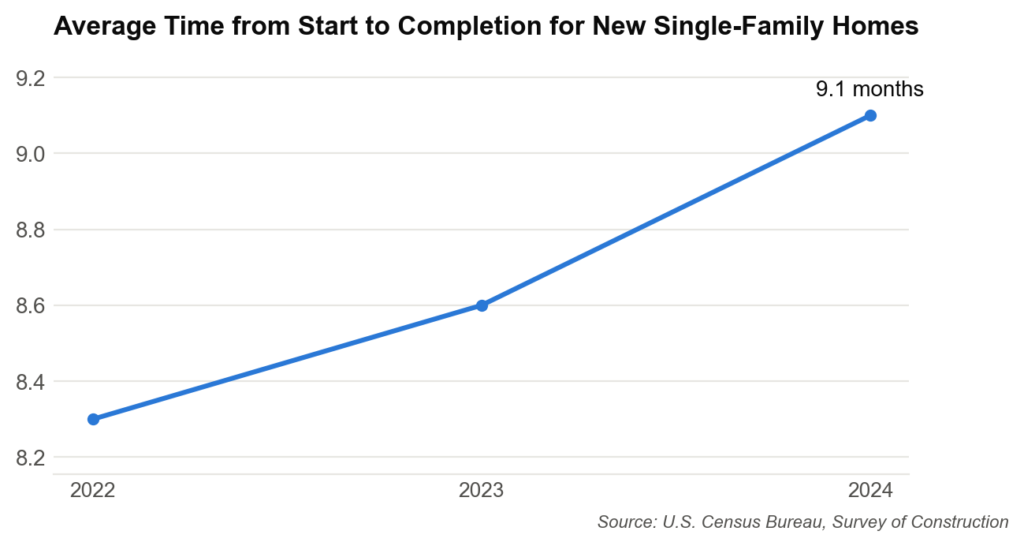
Schedules have not gotten more forgiving either. Census Bureau figures on new single-family construction show the average time from start to completion stretching from 8.3 months in 2022 to 9.1 months in 2024. When the calendar runs long, the week somebody tries to claw back is almost always a trade week inside the shell.
One Plumbing Partner Through Final Testing
What he changed was not a checklist. It was buying the whole scope from one contractor, from the plan review through the final inspection, so the same name sits on the rough-in and on the fixture set. Plan review is where most of it gets decided anyway, because a plumber reading the drawings before the slab pour catches the water heater parked in a closet with no combustion air, or the island drain that wants a vent nobody framed for. Underground then goes in with the finish in mind rather than the inspection in mind. Nobody covers a rough-in that has not held pressure, which sounds too obvious to say out loud until you have watched a drywall crew show up a day early with a full trailer. Months later the same outfit sets the sinks and toilets and owns whatever it finds behind its own work, so there is no seam between the man who ran the line and the man who hung the faucet on it. That seam is where the callbacks live, and a builder who has never gone looking for it will swear the trades are the problem.
Systems coverage is the piece builders tend to underestimate. A June 2026 explainer from Ohio homebuilder Cristo Homes lays out the 1-2-10 warranty standard most new construction follows, meaning 1 year of workmanship coverage on cosmetic and finish defects, 2 years of systems coverage on plumbing and HVAC, and 10 years structural. Two years is a long stretch to own a rough-in somebody else rushed. Terms vary by builder and by state, so the warranty document in the closing packet decides what is actually owed, never the industry shorthand.
Final testing is the other half of the deal. Pressure held on the supply side, water standing in the drain and vent lines, and a walk with the inspector done by the person who installed the system. When the installer is also the one signing off, punch items get corrected that morning instead of becoming a February phone call from a homeowner who has already lost patience.
The Schedule Math After The Change
Run the numbers yourself and substitute your own. Fourteen houses at an average of two and a half plumbing warranty calls apiece in the first year is 35 truck rolls, and at roughly $180 of crew time each that is $6,300. Two of those a year open a wall and pull drywall patch and paint along with them at about $340 a pop, so add another $680. The whole thing comes to $6,980 for the year, none of which shows up on any job cost report because it is spread across twelve months and fourteen addresses. His second year with one plumbing contractor carrying the work through final inspection ran nine callbacks instead of 35.
None of this is an argument for paying more. It is an argument for buying the scope whole, because the discount on a split rough-in resurfaces later as the plumbing repairs Independence MO homeowners call in during the first hard cold snap, against your warranty and inside your own coverage window. Pick the contractor who asks to see the plans before the slab goes down, and who is still on the job the day the inspector signs it off.
