

What does it actually cost to re-skin a commercial building whose siding has given up? That question lands on a property manager’s desk the same week tenants start mentioning the faded panels out front and the heating bill stops making sense. Here is the short version, and it is the argument of this whole piece: a commercial residing job prices out by wall square footage, and on most Front Range strip buildings that total lands below the slow bleed of patching, repainting, and overheating a leaky envelope for another eight years. Siding is not decoration. It is the building’s raincoat, and it is the first thing a prospective tenant judges from the parking lot. Get written bids from the siding installers castle rock co property managers actually keep on file, and the spread between those numbers will tell you more about the job than any online calculator ever could.
Failing Commercial Siding Costs More Than Looks
Cracked, chalky panels are a symptom, not the disease. Colorado sun at 6,200 feet bakes the pigment out of vinyl and opens hairline splits along the nail line, and once water finds those splits it travels behind the panel instead of down the face of it. What we see most often on a 1990s retail strip is a wall that looks merely tired from the sidewalk and reads soaked from the inside, with dark staining across the sheathing and insulation settled into a damp mat at the bottom of the cavity. That damp mat is why the gas bill climbs. Tenants notice the first problem and the accountant notices the second.
Breaking Down What a Residing Job Includes
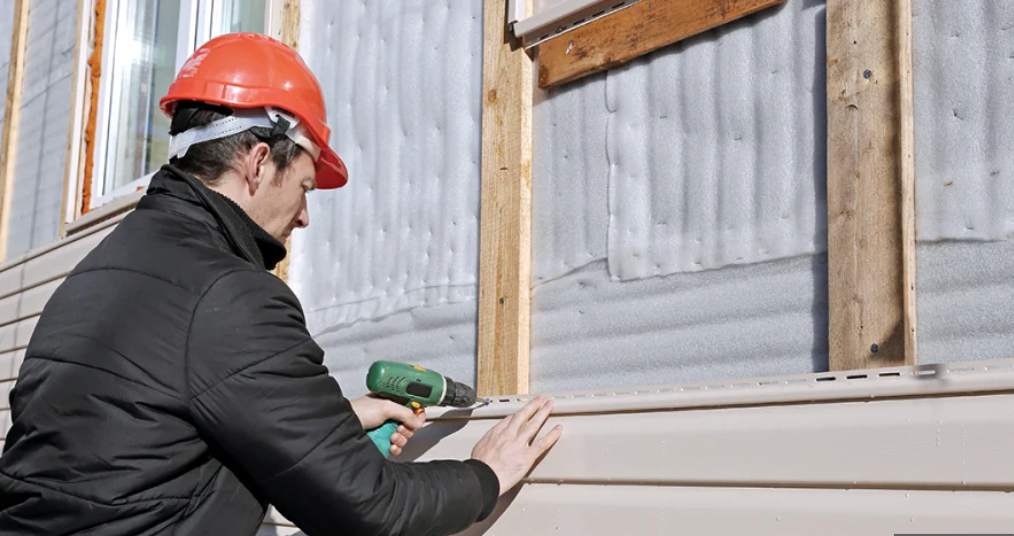
A residing quote is really five line items wearing one number. Tear-off and disposal come first, because the old cladding and any rotted sheathing have to leave the site before anything new goes on. Then comes the weather-resistive barrier, the trim and flashing package, the fasteners, and the cladding itself. Good crews also build in what installers call a rainscreen gap, meaning a deliberate air space behind the panel so any water that sneaks past has somewhere to drain instead of soaking the wall.
Fasteners are where cheap bids hide. FEMA’s Home Builder’s Guide fact sheet on asphalt shingles was written for roofs, but its fastener discipline is the standard every exterior trade should be held to: nails must extend through the sheathing or at least 3/4 inch into the planking, and staples are not acceptable. Ask a bidder what fastener they use and how deep it lands. The answer separates a crew that will still be standing behind that wall in year twelve from one that will not.
While a crew is already mobilized, owners almost always ask about the roof in the same breath. Roofing Contractor’s State of the Roofing Industry report, published in January 2026, pegged laminate shingles as the most popular steep-slope product and roughly 30% of contractor revenue, which is why a roofer quotes them before anything else. That is a roof budget, though, and it is not the one on the table here. Back to the walls.
Running the Numbers on One Storefront
Take a hypothetical Castle Rock retail strip with 6,400 square feet of exposed wall, re-skinned in fiber cement at an installed rate of, say, $11 per square foot, which is $70,400 in material and labor. Tear-off and disposal at $1.75 per square foot adds $11,200. Say 400 square feet of sheathing needs replacing at $4 per foot, another $1,600, plus a trim and flashing package at $6,800 and a commercial permit around $950. That comes to roughly $91,000 all in for the building, or about $14 per square foot of wall.
That is one building, one material, one Colorado summer. Swap fiber cement for insulated vinyl or standing seam metal and the whole line moves, in both directions.
Spending Now Versus Paying Later
Exterior work is expensive everywhere on the building, not only on the walls. Money reports a national average roof replacement of $8,000, typically $5,000 to $10,000 for a house, and commercial square footage scales that figure up quickly. Set either number against a wall assembly that should hold for twenty-five years and the residing total stops looking like a splurge. Deferred maintenance quietly charges interest. Every year you wait, the sheathing repair line grows and the energy penalty repeats itself.
Ask for the bid broken into those five line items instead of one lump figure. The siding installers Castle Rock CO managers rehire are the ones who show tear-off, barrier, flashing, and fastener spec on separate lines, because that is a bid you can actually check against the wall when the work is done. Price the wall by the square foot and the delay by the year, then pick the number you would rather explain to an owner.
